
Training
Mobility training in Clearwater: what your first five sessions look like
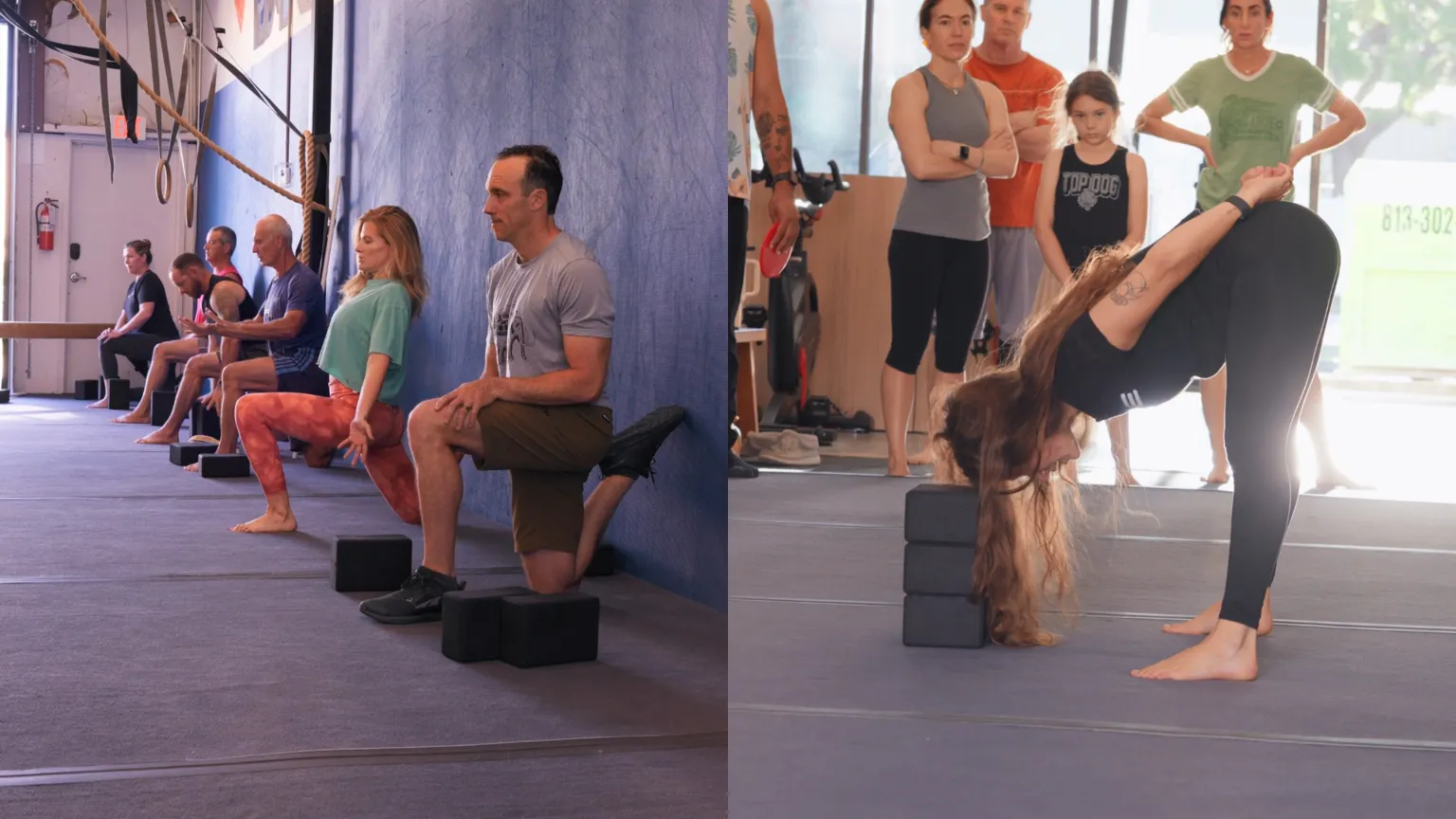
Most people who walk into MOVE for the first time are not beginners. They have been training for years, sometimes decades. They know what a deadlift is. They have a squat program. They have tried stretching before bed, foam rolling after workouts, and at least one YouTube mobility routine that they stuck with for three weeks. And still, when they go to sit into a deep squat, the hips pinch. The shoulder rounds on the press. The lower back grips every time they hinge. If you are looking for mobility training in Clearwater and you have been training hard for a long time, that is probably the picture. Strong in the middle of the range. Stuck at the edges. And slowly going backwards.
Why strong people lose range — and why it matters more than you think
There is a specific kind of frustration that comes from doing the work and watching your body stop cooperating. You are not skipping sessions. You are not being lazy. But the squat is getting shallower. The overhead press is turning into a lower-back extension. The hips that felt fine at 32 now ache at 40. And somewhere in the back of your mind, a quiet worry starts to settle in: is this just what getting older feels like?
It is not. Or at least, it does not have to be. But the explanation matters, because it changes what you actually need to do about it.
When you train hard and move through the same patterns over and over, your nervous system gets very efficient at those patterns. It also gets protective. If you never move your hip through its full range under load, your body learns that the outer range is not safe territory. Tissue gets stiffer. Motor control at end range gets worse. The body is not broken. It is being appropriately conservative. The problem is that a conservative body and a strong, capable body start to diverge. Stiffness begins to cap your strength, not the other way around. You can read more about how this plays out specifically in the squat in our article on why tight hips are capping your squat.
The other thing that happens is compensation. When the hips will not go where the movement demands, the lower back goes instead. When the thoracic spine will not rotate, the lumbar spine takes the rotation. When the shoulder lacks overhead range, the rib cage tips back to fake it. These are not technique failures. They are your body solving a problem with whatever tools it has available. The trouble is that compensations load tissues in ways they were not designed to handle, and that is where old injuries start nagging again, and where new ones get made.
Why what you've already tried hasn't fixed it
The most common response to stiffness is more stretching. Hold the hip flexor longer. Do the couch stretch before squatting. Add a ten-minute cool-down routine. And sometimes this helps, a little, temporarily. But passive stretching in isolation does almost nothing to change how your body moves under load. You can be genuinely flexible in a warm, quiet stretch and still have no motor control at that same range the moment weight goes on the bar. Range you cannot use is not really yours yet.
The second most common response is to push through. Add more weight, trust that the body will adapt, and keep training. For a while, this also seems to work. Until it does not. Until the hip tweak, or the shoulder that will not settle down, or the lower back that goes into spasm for a week after a heavy pull. Pushing through a compensation does not resolve it. It just loads it more.
Big-box gyms and most group class formats are not built to catch this. There is a coach at the front of the room. There are fifteen people moving. Someone might cue "chest up" or "knees out," but nobody is watching your specific hip in your specific squat and seeing that the left side loads differently from the right because of an ankle sprain from 2019. That level of attention is not what those formats are designed to deliver. It is not a criticism. It is just a structural reality.
Physical therapy often helps when an injury is acute. But insurance runs out, discharge happens when pain is gone rather than when function is restored, and the exercises that were useful in a clinical context do not always transfer back into a barbell or rings context. People leave PT feeling better than they did at their worst, but not as good as they were before. And then they go back to training without anyone connecting the two worlds.
The real problem is not your flexibility — it is the gap between range and strength
Here is the reframe that changes what you actually need to do. Mobility is not the same thing as flexibility. Flexibility is passive. Mobility is active range you can control under load. The goal is not to touch your toes in a yoga class. The goal is to squat to depth with a barbell, press a kettlebell overhead without your ribs flaring, hang from a bar with your shoulder in a packed, stable position. That takes more than stretching. It takes strength through range. And building that requires coaching eyes on your body, not a program you follow alone.
This is what the first five sessions at MOVE are designed to address. Not a generic mobility program. Not a list of stretches. A coach's read on exactly where your body is compensating, where the real restrictions are, and a systematic plan to build strength and range together so that one feeds the other.
What mobility training in Clearwater actually looks like across your first five sessions
The programme is called Fundamentals. Everyone at MOVE does it before joining group classes. Not as an upsell. Not as a gate. As preparation. Because a room full of people who have done the work moves differently, coaches more efficiently, and is safer for everyone in it. Here is what those five sessions look like in practice.
Session one: the coach's read
The first session is not a workout. It is an assessment, but not a clinical one. Your coach watches you move. Squat, hinge, press, hang, rotate. They are not looking for perfection. They are looking for the specific places where your body compensates, and for the pattern underneath the compensation. Is the hip restriction coming from the joint itself, or from a tight hip flexor, or from an ankle that will not dorsiflex? Is the shoulder limitation in the capsule, or in the thoracic spine, or in the way you breathe? The answer to that question determines what the next four sessions actually focus on. Two people with the same complaint can have completely different underlying patterns. That is why the first session matters, and why a group class cannot replace it.
Session two: building range where it counts
The second session puts the assessment to work. Your coach targets the specific joints and tissues that are limiting your primary movements. For most people in their late 30s and 40s, that means hips, thoracic spine, and shoulders in some combination. But the work is not passive. You are not lying on a table getting stretched. You are moving through the restricted range under control, building the nervous system's confidence that those positions are safe and accessible. The goal by the end of this session is a measurable change. Not a permanent fix. A first proof that the body can move differently when it is coached correctly.
Session three: clean technique under load
Once the range starts to open, the third session introduces load. Barbell basics, ring support, bodyweight fundamentals. The coach is watching how the new range holds up when the work gets harder. This is where compensations often try to sneak back in. The hips were more open in the warm-up, but the moment the bar goes on the back, the old pattern returns. That is normal. The coach catches it, adjusts it, and teaches you to feel the difference between the compensated position and the real one. That internal feedback is what makes the change stick outside the gym.
Session four: the first skill work
By session four, most people are ready for a first taste of the skill progressions that make MOVE different from a standard strength gym. A wall handstand. A hang from the rings in a good shoulder position. An intro to tumbling mechanics or a basic acrobatic shape. This is not a performance. It is an orientation. It gives you a direction to train toward and a first experience of what it feels like when strength and range are working together. A lot of people describe this session as the moment training starts to feel like play again.
Session five: your plan
The fifth session closes the foundation and opens the door. Your coach puts together a clear picture of what to train next, which group classes fit where you are, and what the ongoing focus should be. You leave with a specific plan, not a general one. And you walk into your first group class as an equal, not as the new person trying to figure out what everyone else already knows.
Alongside the five private sessions, Fundamentals includes two Stretch Series classes. These are coached group mobility sessions that complement the private work and give you a first experience of training alongside other MOVE members. Seven coached sessions total before you ever join a regular class.
What does this actually produce?
MOVE has 155 Google reviews. 153 of them are five stars. The words that appear most often are not words about weight lost or muscle gained. They are words like strong and flexible, meet you where you're at, and feel like a kid again. Physicians train here. A physical therapist. A nurse and a chiropractor. People who understand bodies professionally and chose this environment because of what the coaching delivers.
Members write about squatting deep for the first time in years. About pressing overhead without the lower back taking over. About hanging from a bar after a shoulder surgery that they were told would keep them out of this kind of training for good. These are not outliers. They are what happens when the foundation is built correctly before load is added.
One pattern that comes up consistently in reviews is the difference between training alone or in large classes versus training in a room where the coach knows your name and your body. That distinction is not a marketing claim. It is a structural one. When a coach has seen your assessment, has watched your compensations, and has spent five sessions building your specific foundation, the coaching in a group class is categorically different. They are not cueing a generic pattern. They are watching for your specific thing.
Is this the right fit for where you are right now?
If you are strong but stiff, if old injuries keep interrupting your training, if you have been told to accept limits you do not want to accept, and if you are looking for mobility training in Clearwater that is coached rather than counted, this is worth a conversation. The free intro is not a sales pitch. It is a chance to talk through where you are, what has not worked, and whether MOVE is the right place for the next chapter of your training.
The five sessions are not a shortcut. They are preparation. The difference is that preparation compounds. Every session after Fundamentals builds on a foundation that was actually laid correctly. And that is how people end up saying, five years in, that they are the strongest they have been in a decade.
Mobility training in Clearwater does not have to mean stretching alone in a corner or paying for a class where nobody watches your form. It can mean a coach who has read your body, a plan built around your specific restrictions, and a room full of people who take training as seriously as you do.
Book your free intro and find out where your body actually is, and what it can do from here.
Frequently Asked Questions
What does mobility training in Clearwater at MOVE actually involve?
Mobility training in Clearwater at MOVE is coached, not self-directed. Your first five private sessions combine movement assessment, targeted range work, strength under load, and skill progressions. It is built around what your specific body needs, not a generic program.
Do I need to be flexible to start?
No. Most people who start Fundamentals are strong but stiff, and that is exactly the pattern the programme is designed for. Your coach meets you where you are and builds from there, so current flexibility is not a requirement or a barrier.
How is this different from a regular stretch class or yoga?
Passive flexibility and mobility under load are different things. A stretch class can improve how far you can reach in a quiet position. Fundamentals builds strength through the ranges that matter for your training, so the range holds up when a barbell or a pair of rings is involved.
I had a serious injury or surgery. Can I still do this?
Many MOVE members came in recovering from spine surgery, joint replacements, or chronic pain. The assessment in session one is specifically designed to find what is limiting your movement and work within it. Your coach will not push you into ranges you cannot handle. If your situation is complex, the free intro conversation is a good place to start.
What happens after the five sessions?
After Fundamentals you join group classes with a clear plan and a coach who already knows your body. Your session five summary tells you which classes to prioritize, what to focus on, and what the next progression looks like. You are not starting over in a group setting. You are continuing work that has already begun.
How long before I notice a real difference in my lifts?
Most people feel a measurable change in range within the first two sessions. Whether that translates to a stronger squat or a cleaner overhead press depends on how long the compensation has been in place and how consistently you train. Five sessions lays the foundation. The compounding happens after that.
Ready to put this into practice?
Book a free intro with a MOVE GST coach — they'll build a plan around you, not a template.
Book Your Free Intro