
Training
How to learn a handstand as an adult (the wall comes first)
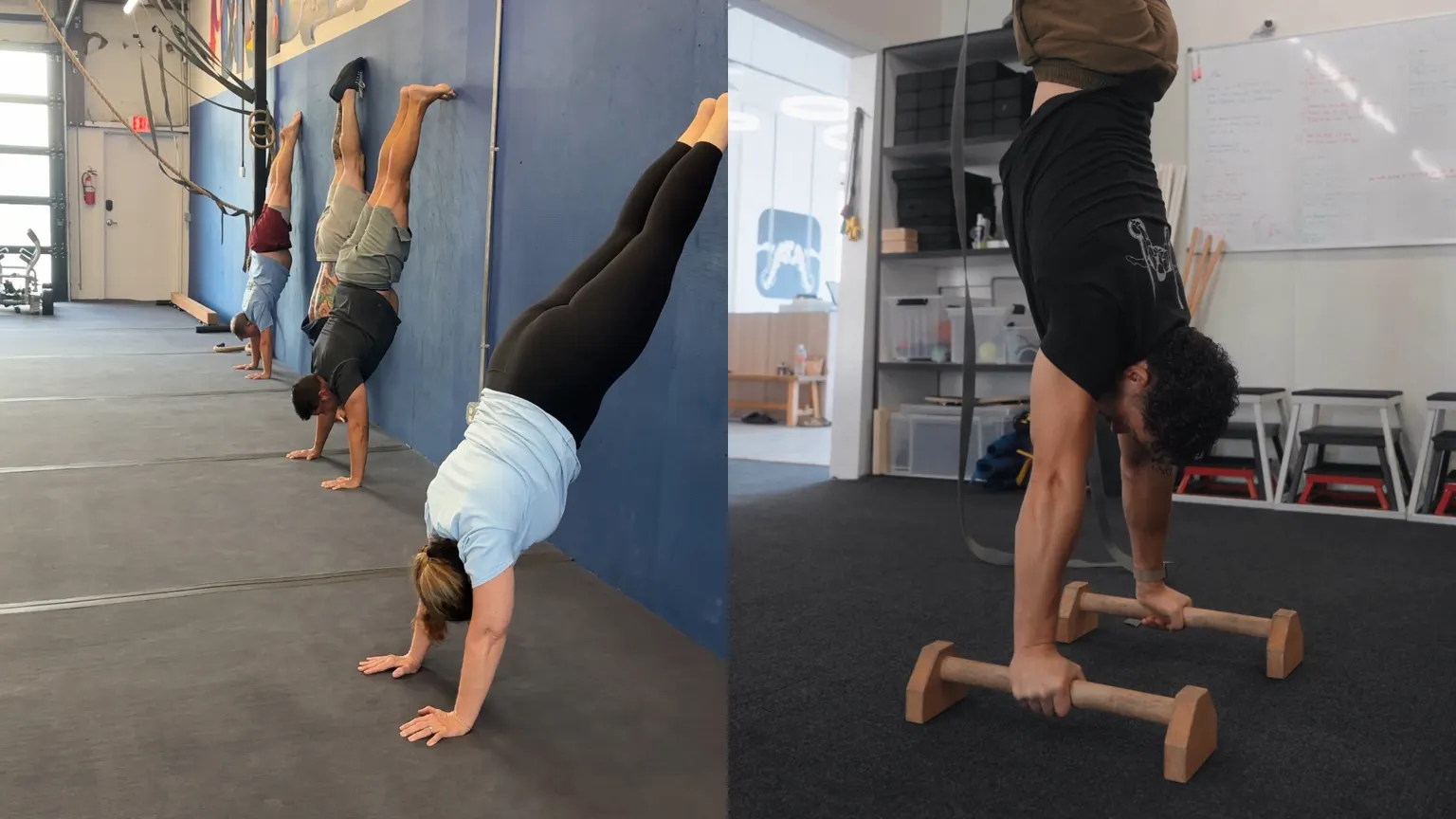
Most adults decide they cannot do a handstand before they ever try. They watched gymnasts as kids, figured the window closed somewhere around age twelve, and filed it away with the rest of the things their body used to be able to do. That story is wrong. Learning to learn handstand as an adult is not about recapturing youth. It is about building something you never actually had: a systematic, coached path from zero to your first solid wall hold, and eventually, free balance.
The wall is where that path starts. Not because it is a beginner shortcut you graduate out of quickly, but because the wall is where you discover what your body is actually doing upside down. Take the wall away too early, and you spend months kicking up and falling over, reinforcing bad habits and building nothing. Keep the wall in the picture — deliberately, patiently — and you build the shoulder position, the body tension, and the spatial awareness that a free handstand actually requires.
Why adults struggle to learn a handstand
The problem is not age. It is two things that often travel together: stiff shoulders and a body that has never learned to be upside down.
Most adults who come into training with serious strength in their squat or deadlift carry a lot of tension through the upper back and shoulders. The overhead position feels compressed. When they try to kick up to a wall, the lower back caves into an arch because the shoulders cannot stack cleanly over the hands. The body compensates by bending somewhere in the middle. The result feels unstable because it is unstable, and the whole thing feels impossible before it has really started.
Add to that a nervous system that has not been upside down in twenty years. Being inverted is disorienting. The first time most adults kick up, they feel a brief spike of fear — not dramatic, but real — and that tension travels straight into the arms and shoulders. Tight arms make a terrible handstand. The body cannot organise itself when it is bracing against falling.
These two problems compound each other. Stiff shoulders make the position wrong. The wrong position feels unstable. Instability creates tension. Tension makes the position worse. Adults get stuck in this loop and conclude they are simply not handstand people. What they actually needed was a coach to slow everything down and address each piece in order.
If tight hips are already affecting your squat, the same pattern is likely showing up in your overhead work. The two problems share roots. Tight hips are capping your squat in ways you may not have connected to your upper body yet.
What people usually try, and why it does not work
The most common approach is to just start kicking up. Set up near a wall, kick, land, repeat. This feels productive because there is obvious effort involved. But kicking up without a foundation is practice at the wrong thing. If the shoulder position is off and the body tension is not there, you are grooving a pattern that will take longer to unlearn than it took to build.
YouTube tutorials help more than nothing, but they are designed for a general audience that the creator cannot see. They cannot tell you that your elbows are flaring, that your head is dropping too far, or that your left shoulder is compensating for a restriction on the right side. The feedback loop is broken.
Group fitness classes rarely include handstand work at all. When they do, the cue is usually a brief demonstration and then everyone attempts it simultaneously while the coach scans the room. Nobody is watching your specific body. Nobody knows that you had a shoulder impingement two years ago that changed how your left arm tracks overhead. The class moves on, and you move on with it, having learned approximately nothing about your handstand.
CrossFit gymnastics progressions are closer to the right idea, but they often move too fast and assume a base level of shoulder mobility and body awareness that many adults simply do not have yet. The athlete who is already reasonably mobile and has some gymnastics background can keep up. The athlete who is strong but stiff gets left behind, often with an injury that confirms their suspicion that this was never really for them.
The reframe: a handstand is a strength skill, not a flexibility trick
Here is where most people's mental model of the handstand needs to shift. It is not a contortion. It is not primarily about being loose or bendy. A handstand is a full-body strength position that requires very specific mobility only in the places it matters: the shoulder girdle, the thoracic spine, and the wrists. Everything else is tension and stacking.
When coaches describe a good handstand, they talk about a hollow body position: ribs down, glutes on, a slight posterior tilt, the whole torso organised into one rigid unit that the shoulders can stack over. That organisation requires genuine strength in the core and the shoulder girdle. It requires the capacity to create and hold tension from fingertips to toes while the body is inverted. That is a skill. It is trained, not stumbled into.
This reframe matters because it changes what you train. If the handstand is a flexibility trick, you go stretch your shoulders and hope for the best. If it is a strength skill with specific mobility requirements, you work the shoulder flexion range you actually need, build the compression strength in the torso and shoulders, and then practise the shape — first on the floor, then at the wall, then progressing toward balance. The path is clear. The work is concrete.
This is also why the handstand belongs in the same training conversation as your barbell work. The shoulder position you need for a solid overhead press and the shoulder position you need for a handstand are more related than most people think. Building one tends to improve the other. Calisthenics and barbell training are not competing approaches — they reinforce each other when the programming is designed that way.
The framework: how to actually learn a handstand as an adult
What follows is the progression used at MOVE. It is not a shortcut. It takes the time it takes, and that time varies by person depending on shoulder mobility, body awareness, and training history. What it does not do is waste your time building the wrong things.
Step one: establish the shoulder range you actually need
Before any handstand work begins, a coach needs to see your overhead range. The test is simple: standing with your back against a wall, arms raised overhead. Can you get your hands flat against the wall without your lower back peeling off? Most people cannot, not cleanly. The lower back arches because the shoulders run out of range and the spine compensates.
This range is not fixed. It responds to specific work. Thoracic extension drills, shoulder flexion progressions, and wrist preparation are the foundation. None of it is complicated, but all of it needs to be targeted to what your specific body is missing. This is the work that happens in the early sessions of Fundamentals, and it is the work that makes everything after it possible.
Step two: learn the shape on the floor before going upside down
The hollow body position can be practised flat on the ground. Lie on your back, arms overhead, and find the position: ribs down, lower back gently imprinted into the floor, glutes engaged, legs together. Hold it. It should feel like the entire front of the body is working. This is the same tension pattern you will need inverted.
Then the pike compression. Seated on the floor, legs straight, fold forward with a flat back and reach the arms alongside the ears. This is the shoulder-to-hip relationship you are building toward in the handstand. Strength in this position — pressing the floor away while holding the fold — directly transfers.
These are not warm-up drills to rush through. They are the foundation. Athletes who skip them and go straight to kicking up against the wall always come back to them eventually, usually after a plateau that could have been avoided.
Step three: the wall kick-up, done deliberately
When the shoulder range and the body tension are present, the wall kick-up becomes a tool for learning, not just an attempt. The goal in this phase is not to get up and stay up. It is to feel what happens to your body when you invert: where your weight shifts, how your shoulders respond to load, what your hands do to find balance.
The kick-up itself is practised slowly. One foot steps close to the wall, the hands go down to shoulder width, and the trailing leg kicks while the lead leg pushes. The first thing to notice is whether the lower back collapses into an arch the moment you are inverted. If it does, that is the hollow body position not yet carrying over. You step down, reset the tension, try again.
At this stage, a coach watching matters enormously. The athlete upside down cannot see their own position. They cannot feel the arch until they know what they are looking for. A coach can cue it in real time, which compresses months of solo practice into weeks of coached practice.
Step four: build time against the wall
Once the kick-up is reliable and the body position is acceptable, the work becomes accumulating time. Not long sets — thirty seconds of solid tension is worth more than three minutes of sagging arch. The target is building shoulder endurance in the correct position.
Chest-to-wall handstands come in here. This variation has the athlete facing the wall rather than away from it, with the chest close to the surface. It forces a hollow body because the wall physically prevents the arch. It also develops balance because the hands must find the pressure through the fingertips. This is a harder variation than it looks, and it is where most of the real adaptation happens.
Step five: beginning to find balance
Balance is not found by kicking away from the wall and hoping. It is found by reducing wall contact incrementally. The athlete in a chest-to-wall hold begins to explore moving slightly away from the wall — a centimetre, two centimetres — and feeling the fingertips respond. The wall is still there. It is still safe. But the nervous system is beginning to learn what free balance feels like.
This phase takes the longest. It is also where training becomes genuinely playful. The first moment both feet leave the wall for even two seconds is a real milestone. It does not look impressive from the outside. From the inside, it is the first handstand.
What this actually feels like in practice
Members at MOVE who go through Fundamentals and continue into skill work describe this progression in a consistent way. The shoulder work in the early sessions feels unglamorous — like mobility homework. Then comes the first time the kick-up lands solidly, and the position actually holds for a few seconds. Something shifts. Training that felt like maintenance starts to feel like progress toward something.
One member, a physician in his late forties who had been lifting for over a decade, described his first chest-to-wall hold as the most focused he had felt in a training session in years. He was not heavier or faster. He was learning something. That feeling — training as skill acquisition rather than just effort accumulation — is what keeps people training for decades rather than years.
The Google reviews for MOVE include members who describe being "the strongest I've been in years" after prioritising mobility and skill work alongside their barbell training. That pairing is not a coincidence. The shoulder health that supports a handstand progression is the same shoulder health that cleans up an overhead press. The body tension that holds a hollow body inverted is the same tension that stabilises a heavy deadlift. The skills are connected.
If you want to understand what the early sessions of this kind of work look like in practice, the article on mobility training in Clearwater: what your first five sessions look like breaks down the process in concrete terms.
Is it too late to learn a handstand as an adult?
The honest answer is: not for most people. There are edge cases — specific shoulder reconstructions, certain nerve conditions — where the handstand is genuinely not the right goal. But the vast majority of adults who believe they are too old, too stiff, or too far past it are working from a story, not from evidence.
What is true is that the path to learning a handstand as an adult looks different from the path a ten-year-old takes in a gymnastics class. The adult path goes through targeted mobility work, deliberate strength building in specific positions, and patient coached progression. It takes longer at the start because there is ground to cover that a child never had to cover. But the adult also brings something the child does not: the capacity to understand the movement, to feel the corrections, and to practise with intention rather than just enthusiasm.
Coached adults at MOVE who start with restricted shoulder range and no handstand background routinely achieve a solid chest-to-wall hold within the first few months of consistent training, and many progress to free balance within a year. That timeline is not a promise — it depends on the individual. But it is a data point that the goal is real, not aspirational.
"Training that felt like maintenance starts to feel like progress toward something. That is the shift."
Ready to start?
The fundamentals program is where everyone starts at MOVE. It is a bundle of private training sessions and classes that allows your coach to learn about your training and injury history, and training goals. Graduation from fundamentals ensures you are ready for all classes, beginner and advanced.
That includes the handstand track. Your coach will assess your shoulder range, identify what is actually limiting you, and build the progression from there. No kicking up and hoping. No classes where nobody watches your form.
If you are serious about learning to learn handstand as an adult — and doing it in a way that also makes your barbell work better, your shoulders healthier, and your training worth showing up for — this is where it starts.
Book your free intro and talk to a coach about where you are starting from. No commitment, no pressure.
Frequently Asked Questions
How long does it take to learn a handstand as an adult?
Most adults with average shoulder mobility can achieve a solid chest-to-wall hold within two to three months of consistent, coached training. Free balance typically takes longer — anywhere from six months to over a year depending on starting mobility, body awareness, and how often you practise. The timeline is honest, not fast, but the progress is real and each stage is useful on its own.
Do I need to be flexible to start handstand training?
You need enough shoulder flexion to stack your arms overhead without your lower back arching severely, and enough wrist extension to load the hands comfortably. Most adults do not start there, but those ranges respond quickly to targeted work. Extreme flexibility is not required — good mechanics and appropriate tension matter far more.
Is it safe to learn a handstand as an adult if I have had a shoulder injury?
It depends on the injury and how well it has resolved. Many adults with previous shoulder impingements, rotator cuff strains, or general wear find that the targeted mobility and strength work in a handstand progression actually improves their shoulder health over time. The key is having a coach who knows your history before the work begins, which is exactly what Fundamentals is designed to provide.
What is the most common mistake adults make when learning handstands?
Skipping the foundation and going straight to kicking up. Without the shoulder range and the hollow body tension established first, every kick-up practises a compromised position. The habit builds quickly and takes time to undo. Starting with the floor drills and the wall progressions feels slower, but it is faster in the end.
How often should I practise handstand work?
Three to four short sessions per week is more effective than one long session. Ten to fifteen minutes of focused wall work and the supporting drills, done consistently, builds the shoulder endurance and body awareness faster than sporadic longer efforts. Quality of position matters more than volume at this stage.
Will handstand training interfere with my barbell lifting?
Generally it complements it rather than competing with it. The shoulder health, body tension, and overhead mobility that handstand work develops tend to improve overhead pressing, support cleaner deadlift setups, and reduce the shoulder compensation patterns that nag lifters over time. Programming them together thoughtfully — which a coach can help with — means they reinforce each other.
Ready to put this into practice?
Book a free intro with a MOVE GST coach — they'll build a plan around you, not a template.
Book Your Free Intro